
Capital Efficiency Revolution: How Sidecars Are Transforming P&C Insurance Investment – Reinsurance

Opportunity and Drivers
While traditional investments struggle with single-digit
returns, reinsurance sidecars are delivering up to 30%+1
returns to institutional investors. This market surged by
40%2 in 2024 to reach $10 billion, as investors
discovered they can collect insurance premiums with limited
downside and 1-5 year exit windows.
Four Forces Created This Perfect Storm
Historically high insurance rates, regulatory pressure on
insurers to find external capital, desperate institutional demand
for yield3 , and AI-powered4 risk modeling
that makes investment decisions more precise than ever.

Participants and Structures
There are three main groups that participate in a reinsurance
sidecar, each seeking to achieve distinct benefits:
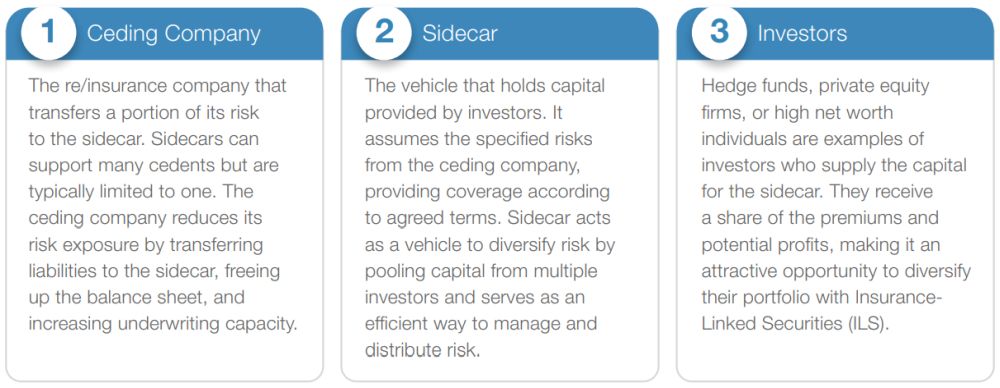
Agreement structures between these groups are dependent upon the
risk profile of the ceding company, investor preferences, and
regulatory environment. That said, quota share, and excess-of-loss
are the two most common in the market.

Revenue Streams
Reinsurance sidecars present an opportunity for high-yield
investments with varying levels of risk appetite, thanks to the
sidecars typically shorter durations and adaptable structures.
Investors are also attracted to their focused risk portfolio. By
underwriting a smaller, more specific book of business, sidecars
limit investors’ exposure compared to the broader range or
risks, insurance types, and geographic areas typically covered by a
re/insurance company’s entire portfolio.
The primary source of revenue for investors is the share of
premiums paid by the ceding company for reinsurance coverage
provided by the sidecar. Capital provided by investors is used to
generate additional investment income. Investors also receive a
portion of the profits from the underwritten policies, which can be
substantial if claims are low. Since sidecars often limit
investors’ exposure to their invested capital, the risk of loss
typically equals no more than the amount invested.
A reinsurance sidecar’s term is typically one to five years,
at which point the SPV is dissolved, and the remaining capital is
returned to investors. If successful, however, re/insurers and
investors often renew the sidecar to further their partnership.
Design Considerations
When establishing a reinsurance sidecar, several considerations
must be addressed to ensure its effectiveness and alignment with
strategic goals.
- Risk coverage
Determine what risks the sidecar will cover, such as in-force
business, new business, or both, and at what levels of quota
shares.
- Investment strategy
Define the types of assets the sidecar will invest in to ensure
organizational alignment with the overall risk and return
objectives.
- Risk transfer pricing
Establish how the risk transfer will be priced, such as setting
the terms of reinsurance premiums and profitsharing
arrangements.
- Domicile
Consider regulatory requirements, tax efficiency, and capital
structures to inform jurisdiction selection. Bermuda and the Cayman
Islands are the most common.
- Control
Identify the level of control the primary re/insurer has over the
sidecar. Equity stakes can vary, so it is important to define
organizational roles in governance and decision-making up
front.
Conclusion
The reinsurance sidecar market has evolved into a $10
billion2 asset class delivering 30%+1 returns with
built-in loss protection. With hard market3 conditions
likely extending through 2027, early movers are positioning
themselves in a rapidly expanding alternative investment
category.
The Opportunity Won’t Last
Elevated rates, uncorrelated returns, and clear exit timelines
make this a compelling alternative to volatile traditional
investments. Will you capitalize before the market becomes
crowded?
Footnotes
1. Artemis.bm, “Sidecar investors ‘handsomely
rewarded’ for commitment in 2023: Aon,” January 5, 2024;
reinsurance-sidecar-market-estimated-at-record-10bn-in-2024-aon-securities/
2. Artemis.bm, “Reinsurance sidecar market estimated
at record $10bn in 2024: Aon Securities,” September 9, 2024;
news/sidecar-investors-handsomely-rewarded-for-commitment-in-2023-aon/
3. Insurance Journal, “Hard reinsurance pricing
conditions are likely to last longer than in previous market
cycles.” August 15, 2024;
insurancejournal.com/news/international/2024/08/15/788486.html
4. Apex Group, “Key trends in Insurance Linked Securities market
in 2024,” March 11, 2024;
Originally published 30 June 2025
The content of this article is intended to provide a general
guide to the subject matter. Specialist advice should be sought
about your specific circumstances.
link